



Watching your child have a seizure can be one of the most distressing moments as a parent. A tonic clonic seizure often looks frightening, but episodes are usually brief and stop on their own. What matters most importantly is knowing what you are seeing, keeping your child safe during the seizure, and getting the right medical guidance afterwards.
This blog explains the tonic clonic seizure meaning, what a generalized tonic clonic seizure looks like in children, common tonic clonic seizure causes, whether tonic clonic seizure is dangerous, and what families should know about tonic-clonic seizure treatment.
A tonic clonic seizure is a seizure with two phases:
In most cases, the child loses awareness and consciousness during the seizure. Afterwards, the child becomes drowsy, confused, emotional, or irritable for a short period. That recovery period is called the post-seizure phase.
During a tonic clonic seizure, the brain’s electrical activity becomes disorganised for a short time, and the body reacts with stiffening and jerking.
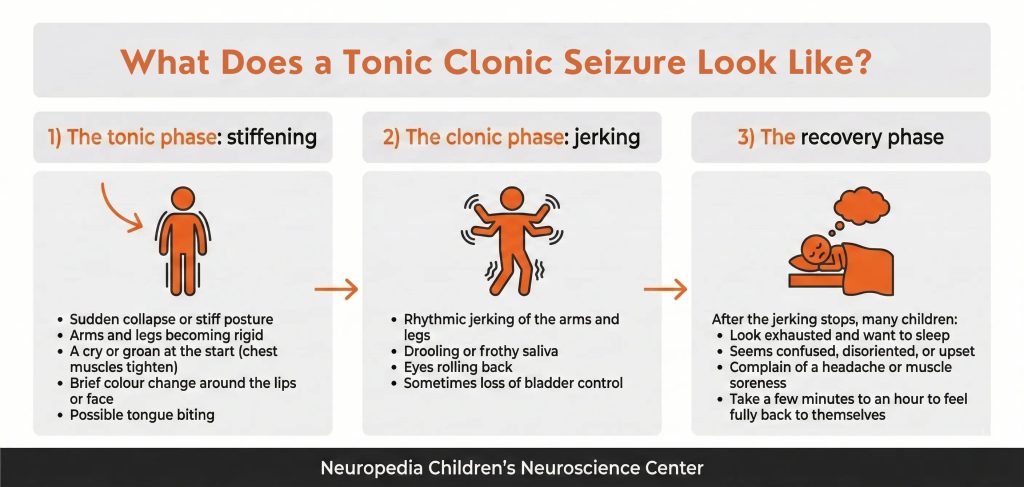
A generalized tonic clonic seizure usually begins suddenly, often without warning. In some children, there may be subtle signs beforehand, but many parents describe it as abrupt.
Most generalized tonic clonic seizures last around one to three minutes. It can feel much longer when you are watching it happen.
| 1) The tonic phase: stiffening You may notice: 1. Sudden collapse or stiff posture. 2. Arms and legs becoming rigid. 3. A cry or groan at the start (this can happen when the chest muscles tighten). 4. Brief colour change around the lips or face. 5. Possible tongue biting. |
2) The clonic phase: jerking You may notice: 1. Rhythmic jerking of the arms and legs. 2. Drooling or frothy saliva. 3. Eyes rolling back. 4. Sometimes loss of bladder control. |
3) The recovery phase After the jerking stops, many children: 1. Look exhausted and want to sleep. 2. Seems confused, disoriented, or upset. 3. Complain of a headache or muscle soreness. 4. Take a few minutes to an hour to feel fully back to themselves. |
A short seizure is not usually dangerous in itself, but it can become risky because of what happens around it.
The main concerns are:
A key red flag is time. A convulsive seizure lasting for more than 5 minutes should be treated as an emergency. The same applies if seizures repeat one after another and your child does not regain awareness between them.
In the moment, your job is safety. You do not need to stop the movements.
| Do this: 1. Stay with your child and keep them in your line of sight. 2. Note the timing as soon as the seizure begins. 3. Ease them to the floor if possible. 4. Protect their head with something soft (a folded jumper, cushion, or your hand). 5. Move sharp objects away and loosen anything tight around the neck. 6. When the jerking stops, turn them onto their side. This helps keep the airway clear. |
Do not do this: 1. Do not restrain their arms or legs. 2. Do not put anything in their mouth. 3. Do not try to give water, food, or tablets until they are fully alert. |
| Call emergency services if: 1. The seizure lasts more than 5 minutes. 2. Your child has repeated seizures without waking fully between them. 3. They have trouble breathing afterwards. 4. They were injured during the episode. 5. This is the first seizure you have ever seen. |
Parents often worry that a seizure automatically means epilepsy. That is not always true. Some seizures happen because of a short-term trigger. Others are part of an ongoing condition that needs long-term care.
Epilepsy-related causes
Acute or temporary causes
Sometimes, even after an in-depth evaluation, the cause is not immediately clear. That does not mean the medical team is missing something. It means the next step is a structured follow-up.
If it is safe to do so, write down what you noticed. A short phone video can be helpful, but never put yourself at risk to capture it.
Helpful details include:
This kind of information can help clinicians distinguish among different seizure types and determine which tests are most useful.
Assessment begins with a detailed history and a physical examination. As per the situation, doctors recommend:
The plan depends on age, symptoms, recovery, medical history, and the clinician’s findings.
Treatment depends on what caused the seizure and whether it is likely to recur.
If the seizure was provoked
If there is a clear trigger, such as low blood sugar, abnormal sodium levels, or an infection, the priority is treating the cause. Some children may not need long-term seizure medication if the seizure was linked to a correctable, short-term problem.
If epilepsy is suspected or confirmed
Your clinician may recommend:
Medication choice is not one-size-fits-all. It depends on seizure type, age, other health conditions, and side-effect considerations. Your child’s neurologist will guide this carefully.
Many families feel better once they have a clear safety plan. Common precautions include:
Children with seizures should still be children. The aim is to reduce preventable risks without shrinking their life expectancy.
When you are dealing with seizures, families often need more than a single appointment. They need clarity, continuity, and a team that can connect diagnosis to daily living.
Neuropedia Children’s Neuroscience Center provides:
If your child has had a seizure or you are concerned about recurrent episodes, early specialist assessment at Neuropedia Children’s Neuroscience Centre can make a significant difference in safety, confidence, and long-term outcomes.
A tonic clonic seizure is frightening to witness, but you are not powerless in that moment. Timing the seizure, keeping your child safe, and knowing when to seek urgent help are the practical steps that matter most. After that, the right medical team can help you understand why it happened, whether it is likely to happen again, and what support your child needs to stay safe and well.
For an early assessment and support, contact Neuropedia Children’s Neuroscience Center today.


