


| Condition | Nonverbal or nonspeaking autism |
| What does nonverbal mean? | Using very few or no spoken words for communication |
| Can children understand language? | Yes. Many understand much more than they can express. |
| Main symptoms | Limited speech, difficulty communicating, repetitive behaviours, sensory differences and social communication challenges |
| Causes | A combination of genetic and brain development factors. There is no single known cause. |
| Can speech develop later? | Some children develop speech over time, while others communicate successfully using alternative methods. |
| Treatment | A combination of speech and language therapy, occupational therapy, behavioural therapy and early intervention, tailored to the child. |
If you have noticed that your child is not talking as expected, it is natural to have questions and concerns.
While every child develops at their own pace, delayed or absent speech can sometimes be a sign of nonverbal autism. Understanding what this means is the first step towards getting the right support.
This guide explains what nonverbal autism means, what causes it, and how it is treated, so you know what steps to take next.
Nonverbal autism describes autistic individuals who use very little spoken language or do not speak at all. Some children may only use a few words, while others rely entirely on alternative ways to communicate.
It is important to know that nonverbal autism is not its own medical condition. It sits under the broader diagnosis of autism spectrum disorder (ASD). Many healthcare professionals now prefer the term nonspeaking autism because it more accurately describes a person’s speech without suggesting they have nothing to say.
Being nonverbal autistic does not mean a child cannot think, learn or understand. Many nonspeaking autistic children understand far more than they can express and communicate effectively in other ways.
A child with nonverbal autism may:
For example, a child may point to a favourite toy, bring you an object they want help with, use gestures or press buttons on a communication device instead of speaking.
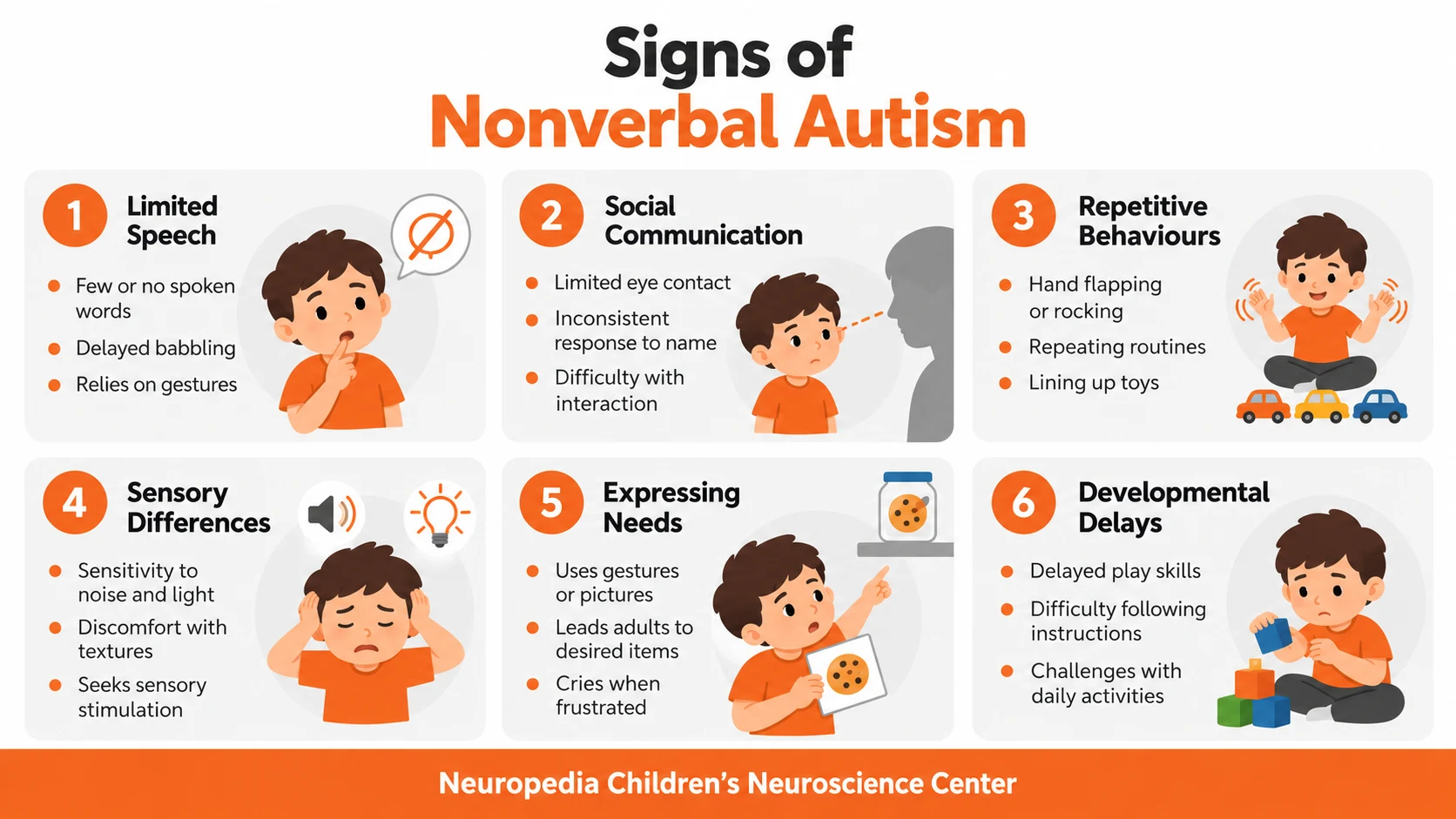
Every autistic child is different, but common signs of nonverbal autism include:
Little to no spoken languageA child may: ● Not babble as expected during infancy ● Have very few spoken words ● Stop using words they previously learned ● Rarely imitate sounds or speech ● Depend on gestures rather than words Speech development can be delayed without autism, so this sign should always be considered alongside other developmental features. |
Difficulty with social communicationChildren with nonverbal autism may: ● Respond inconsistently when their name is called ● Have limited eye contact ● Find it difficult to initiate interactions ● Show reduced use of pointing to share interest ● Struggle with turn-taking during play These behaviours are linked to differences in social communication rather than a lack of interest in other people. |
Repetitive behaviourMany autistic children display repetitive movements or behaviours, including: ● Hand flapping ● Rocking ● Spinning objects ● Repeating routines ● Lining up toys ● Becoming distressed when routines change These behaviours can help children regulate emotions or respond to sensory experiences. |
Sensory differencesSome children experience the world differently. They may be unusually sensitive to: ● Loud noises ● Bright lights ● Certain textures ● Clothing labels ● Food textures Others may actively seek sensory experiences, such as spinning, jumping or deep pressure. |
Difficulty expressing needsWithout spoken language, children may: ● Pull a parent’s hand towards an object ● Cry when frustrated ● Use gestures ● Point to pictures ● Lead caregivers to what they want Teaching alternative communication methods often reduces frustration and supports greater independence. |
Delayed developmental milestonesSome children may also experience delays in: ● Play skills ● Learning gestures ● Following instructions ● Daily living skills ● Social interaction Every child develops at their own pace, which is why a comprehensive developmental assessment is important. |
If you notice several of these signs, it is worth speaking to a paediatrician or paediatric neurologist for an assessment.
Nonverbal autism is thought to result from a combination of factors, including:
Researchers have not found one single cause, and it is not the result of anything a parent did or did not do. Ongoing research continues to look at genetic and neurological factors involved in speech development in autism.
There is no single test for nonverbal autism. Instead, a paediatric neurologist or developmental paediatrician will usually carry out:
An early, thorough diagnosis helps families understand their child’s needs and access the right support as soon as possible.
Many parents ask this, and it is a fair question. Some nonspeaking autistic children do go on to develop spoken language, particularly with early and consistent speech therapy. Others may always communicate mainly through other means, such as gestures, sign language, or communication devices.
Every child is different, so it’s not possible to predict whether a child will learn to speak. Progress may be influenced by:
The goal of treatment is not simply to encourage speech. It is to help your child communicate in the way that works best for them, whether that involves spoken language, sign language, pictures or communication technology.
Speech isn’t the only way to communicate. Many nonspeaking autistic children benefit from:
These tools are not a replacement for speech therapy. They often work alongside it, giving a child a reliable way to communicate while speech skills are being developed.
There is no single nonverbal autism treatment that works for every child. A combination of therapies, tailored to the individual, tends to bring the best results.
Speech therapy helps children improve communication, whether through spoken language or alternative methods such as gestures, picture communication or speech-generating devices. It also supports language understanding and social interaction.
Occupational therapy focuses on daily living skills, fine motor development, play, sensory processing and independence at home and school.
Behavioural therapy helps children build communication, social and learning skills while supporting positive behaviours and reducing challenges that affect everyday life.
Early intervention is one of the most important parts of nonverbal autism treatment. Starting therapy as early as possible gives children more opportunities to develop communication, social and developmental skills during the early years, when the brain is growing rapidly.
Parents are an important part of treatment. They learn practical strategies to encourage communication, support development, and reinforce therapy techniques during everyday activities.
You should consider seeking medical advice if your child:
Trust your instincts. If something feels different about your child’s development, an assessment can bring clarity and open the door to support.
If you are concerned that your child is showing signs of nonverbal autism, seeking an assessment early can provide answers and help you access the right support. Every child communicates differently, and recognising their strengths is an important part of helping them learn, connect with others and become more independent.
At Neuropedia, we provide evidence-based assessment and support tailored to each child. Families choose us because we offer:
Early intervention can make a meaningful difference by helping children build communication skills, whether through speech or alternative methods.