




We often imagine language starting small: a first word, then another, slowly building into sentences.
But for some children, language arrives in different ways. It comes in full lines, familiar phrases, and meaningful echoes of what they’ve heard before. These repetitions are not random; they’re purposeful communication.
This pattern is called Gestalt Language Processing, and recognizing it opens a window into how many autistic children experience and share their world.
In this blog, we’ll learn what Gestalt Language Processing is, the stages children move through, and how you can help Gestalt Language Learners to better support authentic communication.
Gestalt Language Processing (GLP) is a natural language development style in which a person learns and understands speech in larger units of meaning rather than starting with individual words.
Instead of building language piece by piece, Gestalt processors first absorb and use whole expressions that carry emotional tone, context, and intent.
Over time, these larger language units are gradually analyzed and reorganised, allowing the individual to form more flexible and original language. This developmental pathway reflects a difference in how language is processed, not a deficit or disorder.
GLP is often observed in many autistic individuals, though it is not exclusive to autism. It represents one of the valid ways human communication can develop.
Recognizing Gestalt language processing examples in daily life helps parents understand what their child may be communicating. These speech patterns often have meaning, even if they sound unusual at first.
Parents may notice their child:
These patterns are not random or meaningless. They usually reflect memory, emotion, and understanding expressed through stored language units.
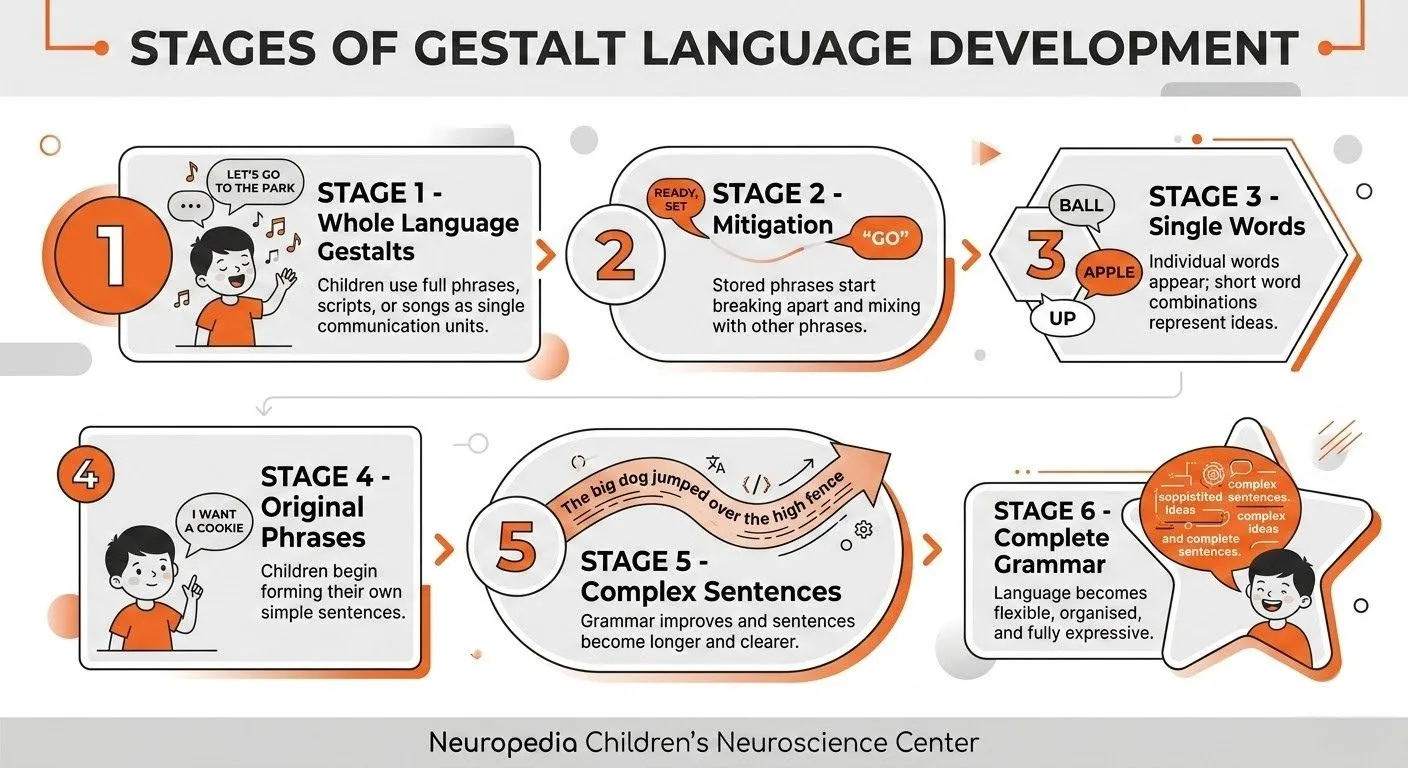
Gestalt Language Processing stages describe how some children move from using memorised language chunks to producing flexible, original speech. Not every child progresses in the same way or at the same pace, and there is no fixed timeline for moving through these stages:
Stage 1 – Whole language Gestalts: Children use full language units such as scripts, songs, or entire phrases as single pieces of communication.
Stage 2 – Mitigation: Stored phrases begin to break apart. Children may shorten them or mix parts from different phrases.
Stage 3 – Single words: Individual words are pulled from gestalts. Children may also use short word combinations to represent a single idea or concept.
Stage 4 – Original phrases: They begin forming their own simple sentences and expressing ideas more independently.
Stage 5 – More complex sentences: Grammar develops further, and sentences become longer and more detailed.
Stage 6 – Complete grammar: Language becomes flexible, organised, and fully generative, allowing for complex expression and supportive conversation.
Understanding these stages helps adults recognise progress and respond supportively, while remembering that this path reflects a difference in language development style, not a development delay or deficit.
Gestalt Language Processing (GLP) is often associated with autism because many autistic children naturally learn language in larger, meaningful chunks rather than word by word.
Importantly, using GLP does not mean a child is autistic. Gestalt language processing is seen in both neurotypical and neurodivergent people. Neurodivergence can include individuals with autism spectrum disorder, ADHD, Down syndrome, and other developmental differences. GLP is a language learning style, not a diagnosis.
Many people connect GLP and autism because of echolalia, which is when a child repeats words or phrases they have heard before. Echolalia is common in autistic children, but it is just one part of GLP, not the whole thing. It often helps children connect, show feelings, or share experiences as they learn language.
Understanding the relationship between GLP and autism helps shift perspective. Instead of viewing scripted language as something to stop, adults can recognise it as communication in progress, a valid and purposeful step in a child’s language journey.
You don’t need to be a speech therapist to nurture language growth. You just need to be present, observant, and willing to notice meaning where others might miss it. Support starts with connection, not correction.
Even though gestalt speech is a natural way many children begin communicating, a speech-language evaluation can be a helpful step in supporting their communication development.
Caregivers might consider an evaluation if a child is:
Both you and your child will attend the evaluation. In addition to assessing your child, the speech therapist observes your child’s communication, asks about what you notice at home, and may review audio or video recordings to better understand speech patterns and identify features such as scripting or melodic phrasing.
Speech therapy for Gestalt language processors is usually individualised, child-led, and play-based. Instead of drills, sessions focus on connection, engagement, and modeling language that feels meaningful to the child. When therapy follows a child’s interests, they’re more likely to participate and communicate naturally.
During early sessions and intake, caregivers are usually involved in conversations about:
Sessions may also include:
Overall, Gestalt-focused therapy aims to understand how a child processes language and then supports development from that starting point, rather than forcing them into a different communication style.
Neuropedia is recognized as one of the leading speech therapy centers in Dubai and Sharjah, offering specialised support for children with diverse communication styles, including Gestalt language processors.
Our team uses research-based, child-centered approaches to understand how each child learns language and to design therapy that supports natural development. We also work closely with parents, guiding them with practical strategies to encourage communication at home. Many families have already seen meaningful progress through our personalised programs.