


 04 343 1113
 info@neuropedia.ae


We often imagine language starting small: a first word, then another, slowly building into sentences.
But for some children, language arrives in different ways. It comes in full lines, familiar phrases, and meaningful echoes of what they’ve heard before. These repetitions are not random; they’re purposeful communication.
This pattern is called Gestalt Language Processing, and recognizing it opens a window into how many autistic children experience and share their world.
In this blog, we’ll learn what Gestalt Language Processing is, the stages children move through, and how you can help Gestalt Language Learners to better support authentic communication.
What is Gestalt Language Processing (GLP)?
Gestalt Language Processing (GLP) is a natural language development style in which a person learns and understands speech in larger units of meaning rather than starting with individual words.
Instead of building language piece by piece, Gestalt processors first absorb and use whole expressions that carry emotional tone, context, and intent.
Over time, these larger language units are gradually analyzed and reorganised, allowing the individual to form more flexible and original language. This developmental pathway reflects a difference in how language is processed, not a deficit or disorder.
GLP is often observed in many autistic individuals, though it is not exclusive to autism. It represents one of the valid ways human communication can develop.
What Are Some Everyday Examples Parents Might Notice?
Recognizing Gestalt language processing examples in daily life helps parents understand what their child may be communicating. These speech patterns often have meaning, even if they sound unusual at first.
Parents may notice their child:
- Repeating familiar phrases tied to strong emotions or familiar routines
- Using the same line in different situations because it carries a general meaning for them
- Echoing questions or statements instead of answering directly
- Repeating language they heard earlier or in the past
- Using a familiar phrase when excited, overwhelmed, or seeking comfort
- Saying something that seems unrelated but actually reflects how they’re feeling internally
- Returning to specific lines or scripts during play or transitions
These patterns are not random or meaningless. They usually reflect memory, emotion, and understanding expressed through stored language units.
What Are the 6 Stages of Gestalt Language Development?
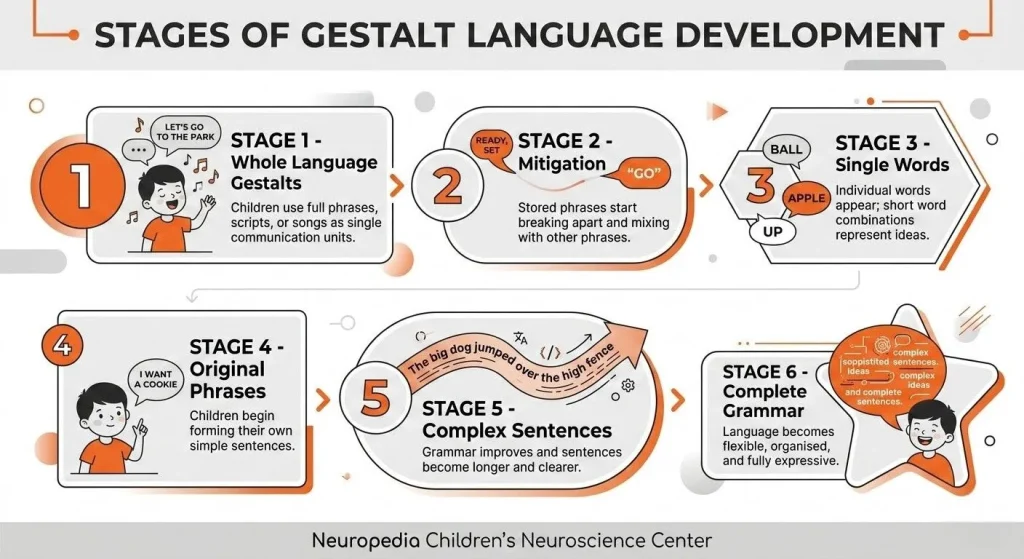
Gestalt Language Processing stages describe how some children move from using memorised language chunks to producing flexible, original speech. Not every child progresses in the same way or at the same pace, and there is no fixed timeline for moving through these stages:
Stage 1 – Whole language Gestalts: Children use full language units such as scripts, songs, or entire phrases as single pieces of communication.
Stage 2 – Mitigation: Stored phrases begin to break apart. Children may shorten them or mix parts from different phrases.
Stage 3 – Single words: Individual words are pulled from gestalts. Children may also use short word combinations to represent a single idea or concept.
Stage 4 – Original phrases: They begin forming their own simple sentences and expressing ideas more independently.
Stage 5 – More complex sentences: Grammar develops further, and sentences become longer and more detailed.
Stage 6 – Complete grammar: Language becomes flexible, organised, and fully generative, allowing for complex expression and supportive conversation.
Understanding these stages helps adults recognise progress and respond supportively, while remembering that this path reflects a difference in language development style, not a development delay or deficit.
The Connection Between Gestalt Language Processing and Autism
Gestalt Language Processing (GLP) is often associated with autism because many autistic children naturally learn language in larger, meaningful chunks rather than word by word.
Importantly, using GLP does not mean a child is autistic. Gestalt language processing is seen in both neurotypical and neurodivergent people. Neurodivergence can include individuals with autism spectrum disorder, ADHD, Down syndrome, and other developmental differences. GLP is a language learning style, not a diagnosis.
Many people connect GLP and autism because of echolalia, which is when a child repeats words or phrases they have heard before. Echolalia is common in autistic children, but it is just one part of GLP, not the whole thing. It often helps children connect, show feelings, or share experiences as they learn language.
Understanding the relationship between GLP and autism helps shift perspective. Instead of viewing scripted language as something to stop, adults can recognise it as communication in progress, a valid and purposeful step in a child’s language journey.
How Can You Support Gestalt Language Development?
You don’t need to be a speech therapist to nurture language growth. You just need to be present, observant, and willing to notice meaning where others might miss it. Support starts with connection, not correction.
- Model, don’t test: Skip drills and speak naturally. Narrate daily life with warmth and curiosity so language is experienced, not demanded. Children learn through shared moments, not pressure.
- Respect their scripts: When your child uses a familiar phrase, assume it means something and respond to what they are trying to say. This builds trust, understanding, and emotional safety.
- Use predictability and routine: Songs, rituals, and familiar daily patterns make language easier to process and remember. Predictability creates comfort, and comfort supports learning.
- Follow their lead: Start with your child’s interests. When you join them in what they enjoy, communication feels more natural and motivating.
- Incorporate AAC and visuals: Augmentative and Alternative Communication (AAC) tools, such as picture supports or speech-generating devices, expand expression and reduce frustration. AAC supports language development rather than replacing speech.
- Prioritise regulation over output: If your child is overwhelmed, pause language expectations and focus on helping them feel calm and safe. Regulation is the foundation on which communication grows.
When to Seek a Speech Language Evaluation?
Even though gestalt speech is a natural way many children begin communicating, a speech-language evaluation can be a helpful step in supporting their communication development.
Caregivers might consider an evaluation if a child is:
- Copying chunks of language from TV, movies, YouTube videos, or songs
- Speaking in sing-song or highly melodic patterns
- Picking up on tone, rhythm, and feeling before focusing on the actual words
- Using long or hard-to-understand strings of speech
Both you and your child will attend the evaluation. In addition to assessing your child, the speech therapist observes your child’s communication, asks about what you notice at home, and may review audio or video recordings to better understand speech patterns and identify features such as scripting or melodic phrasing.
Gestalt Speech Therapy: What Do Sessions Often Look Like?
Speech therapy for Gestalt language processors is usually individualised, child-led, and play-based. Instead of drills, sessions focus on connection, engagement, and modeling language that feels meaningful to the child. When therapy follows a child’s interests, they’re more likely to participate and communicate naturally.
During early sessions and intake, caregivers are usually involved in conversations about:
- The child’s interests and favorite activities
- Their daily environment and where their language input comes from
- Situations or emotions connected to repeated phrases or scripts
- Communication patterns noticed at home
- Sensory preferences or regulation needs
Sessions may also include:
- Play-based interaction instead of table work
- Modeling flexible language rather than correcting speech
- Expanding on the child’s phrases naturally
- Using visuals, AAC tools, or gestures when helpful
- Supporting emotional regulation alongside communication
Overall, Gestalt-focused therapy aims to understand how a child processes language and then supports development from that starting point, rather than forcing them into a different communication style.
Why Choose Neuropedia for Gestalt Language Processing support?
Neuropedia is recognized as one of the leading speech therapy centers in Dubai and Sharjah, offering specialised support for children with diverse communication styles, including Gestalt language processors.
Our team uses research-based, child-centered approaches to understand how each child learns language and to design therapy that supports natural development. We also work closely with parents, guiding them with practical strategies to encourage communication at home. Many families have already seen meaningful progress through our personalised programs.


.png)


