



The rapid rise of digital screens in early childhood has changed the way young children play, learn, and communicate. While technology offers benefits, prolonged exposure during the most sensitive years of brain development can interfere with a child’s ability to engage, respond, and learn from real-world interactions.
This pattern has led to increasing awareness of virtual autism, a term used to describe autism-like difficulties linked to excessive screen exposure rather than genetic or neurological causes.
Although virtual autism is not a formal medical diagnosis, clinicians across the world are seeing children who develop communication delays, social withdrawal, and behavioural challenges that improve when screens are limited and meaningful human interaction increases.
Through this blog, you will understand how this concept is vital for parents, caregivers, and educators, especially during the first three years of life when the brain is most receptive to sensory-motor and social experiences.
Virtual autism refers to a cluster of developmental symptoms, speech delay, poor eye contact, reduced social interaction, and repetitive behaviours that appear after a child spends long hours interacting with screens.
Psychologists introduced the term to describe behavioural changes in children aged 0–3 who are deprived of sensory and social input due to digital overexposure.
The condition arises when screens replace essential developmental activities such as face-to-face communication, exploration, imaginative play, and physical movement. Unlike autism spectrum disorder (ASD), which has lifelong neurodevelopmental origins, virtual autism is environmentally driven and potentially reversible.
Key features:
• Symptoms appear after extended screen exposure
• Difficulties improve when screens are reduced
• Child demonstrates better engagement in real-world settings
• No underlying neurological condition is found
Parents often seek clarity around what virtual autism is, especially when symptoms mimic ASD (Autism Spectrum Disorder). Timely evaluation is crucial for preventing misdiagnosis and initiating early intervention.
Current research highlights several mechanisms through which screens influence early development:
Screens limit the everyday experiences that build communication and social skills. Without shared attention, imitation, turn-taking, and eye contact, language and emotional regulation develop more slowly.
Heavy screen use may reduce GABA levels, a neurotransmitter essential for language development, calm focus, and behavioural control. Disturbances in melatonin, dopamine, and serotonin have also been reported in children who have been exposed to devices for prolonged periods of time.
Blue light suppresses the production of melatonin, leading to poor sleep. Sleep deprivation further affects mood, attention, and learning.
Studies show differences in white and grey matter density in children with extensive daily screen exposure, particularly in regions responsible for speech, executive function, and social understanding.
Children under three learn through movement and tactile exploration. Replacing these activities with passive screen time restricts critical sensory and motor input.
Parents often notice the following virtual autism symptoms developing gradually:
• Delayed speech or reduced vocabulary
• Limited attempts to express needs
• Reduced response to name
• Regression in previously acquired words
• Less eye contact
• Preference for screens over people
• Reduced interest in interactive play
• Lack of imitation or shared attention
• Irritability or tantrums when screens are removed
• Rigid routines or repetitive actions
• Short attention span
• Hyperactivity when not using devices
• Difficulty regulating emotions
• Heightened or muted responses to sensory input
• Flat affect during non-screen activities
These overlaps with ASD can cause understandable concern, but the pattern of improvement with reduced screen use helps differentiate the two.
Although both conditions share similarities, their roots are different:
| Feature | Virtual Autism | Autism Spectrum Disorder |
| Cause | Excessive screen exposure | Genetic and neurodevelopmental |
| Onset | After increased digital use | Present from early infancy |
| Reversibility | Often reversible | Lifelong condition |
| Response to Intervention | Rapid improvement with environmental change | Requires long-term therapy |
Virtual autism does not mean a child has ASD. It represents a developmental deviation caused by environmental overstimulation rather than innate neurological differences.
With early action, children often show improvement within weeks. Encouraging virtual autism recovery signs include:
• Increased eye contact
• Improved response to name
• New words emerging
• Greater curiosity about people
• More imaginative play
• Reduced irritability
• Longer attention spans
Typical virtual autism recovery time ranges from a few weeks to several months, depending on age and severity. Consistent intervention leads to the strongest outcomes.
There is no formal diagnostic tool specifically for virtual autism. Clinicians usually begin with established ASD screening methods while reviewing:
• Screen-time patterns
• Sleep patterns
• Developmental milestones
• Parent–child interaction
• Behavioural changes after reducing digital exposure
A supervised trial of reduced screen time is often revealing. When symptoms improve, the pattern suggests screen-related developmental delay rather than ASD.
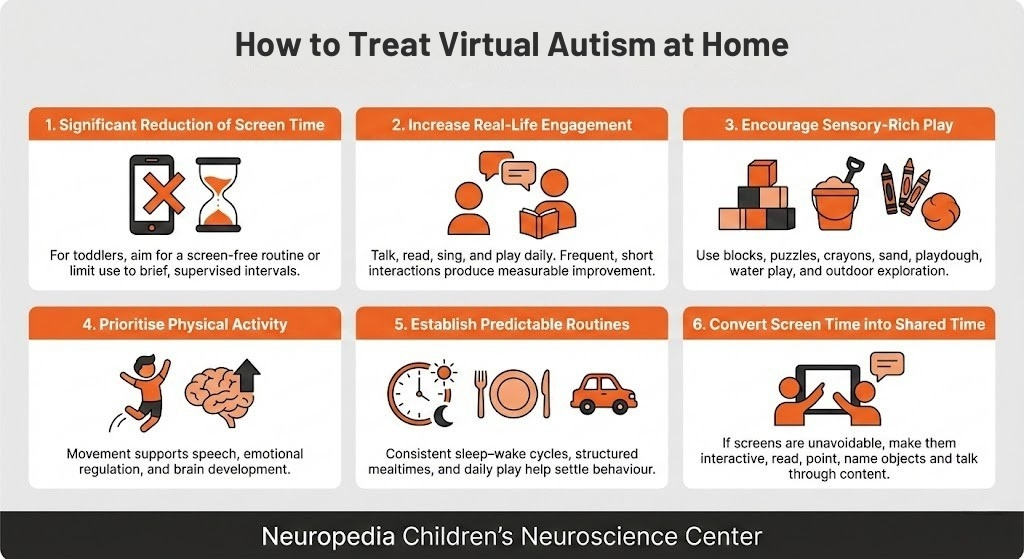
Parents play a central role in recovery. Practical strategies include:
For toddlers, aim for a screen-free routine or limit use to brief, supervised intervals.
Talk, read, sing, and play daily. Frequent, short interactions produce measurable improvement.
Use blocks, puzzles, crayons, sand, playdough, water play, and outdoor exploration.
Movement supports speech, emotional regulation, and brain development.
Consistent sleep–wake cycles, structured mealtimes, and daily play help settle behaviour.
If screens are unavoidable, make them interactive, read, point, name objects and talk through content.
These steps, combined with early assessment, help reverse symptoms effectively.
As the first specialised paediatric neuroscience centre in the UAE, Neuropedia Children’s Neuroscience Center offers comprehensive, multidisciplinary expertise for infants, children and young people with developmental, behavioural, neurological and psychological concerns.
Neuropedia brings together paediatric neurologists, child psychiatrists, developmental paediatricians, psychologists, speech therapists, physiotherapists, occupational therapists, behavioural therapists and dietitians all trained in the UK, Europe and the United States.
Care at Neuropedia is grounded in:
• Accurate and early diagnosis
• Holistic, family-centred treatment
• Collaborative, interdisciplinary decision-making
• Long-term developmental support under one roof
The centre supports children from birth to sixteen (and up to eighteen in special cases), ensuring that families receive clear guidance from the first assessment to rehabilitation and follow-up.
Neuropedia’s mission emphasises integrity, quality, trust, and continued education, making it a regional leader in children’s neuroscience and developmental care.
Virtual autism is a growing phenomenon, reflecting the modern shift in how young children interact with the world. Although the symptoms can be concerning, the encouraging reality is that virtual autism is often reversible.
By reducing screen exposure, prioritising human interaction, and seeking specialist guidance, children can regain developmental skills and thrive.
For families seeking expert assessment and early intervention, Neuropedia offers world-class, child-centred neurological and developmental care to support every stage of a child’s growth.
Schedule a consultation today with Neuropedia for a comprehensive plan on your child’s growth and development.


