


 04 343 1113
 info@neuropedia.ae


As a parent, few things are as exciting as hearing your child’s first words. However, when those milestones are delayed, or when your child’s speech remains difficult to understand long after their peers have started chatting, it is natural to feel concerned.
At Neuropedia, we often see parents who are unsure if their child is simply a “late bloomer” experiencing a typical speech delay or if they are facing a more complex neurological condition known as childhood apraxia of speech (CAS). Understanding the distinction is the first step toward getting your child the specialised support they need.
What is Apraxia of Speech?
To understand what apraxia of speech is, it helps to look at how we produce sound. Speech is a highly coordinated dance between the brain and the muscles of the mouth. In a typical child, the brain sends a “blueprint” of movement to the lips, tongue, and jaw, which then executes that plan perfectly.
Childhood apraxia of speech (CAS) is a motor speech disorder. In children with CAS, the muscles themselves are perfectly healthy and strong, but the brain struggles to plan and sequence the complex movements required for speech.
It’s not that the child doesn’t know what to say; it’s that the brain’s “command centre” cannot send the correct “instructions” to the mouth muscles.
Delay vs Apraxia: What’s the Difference?
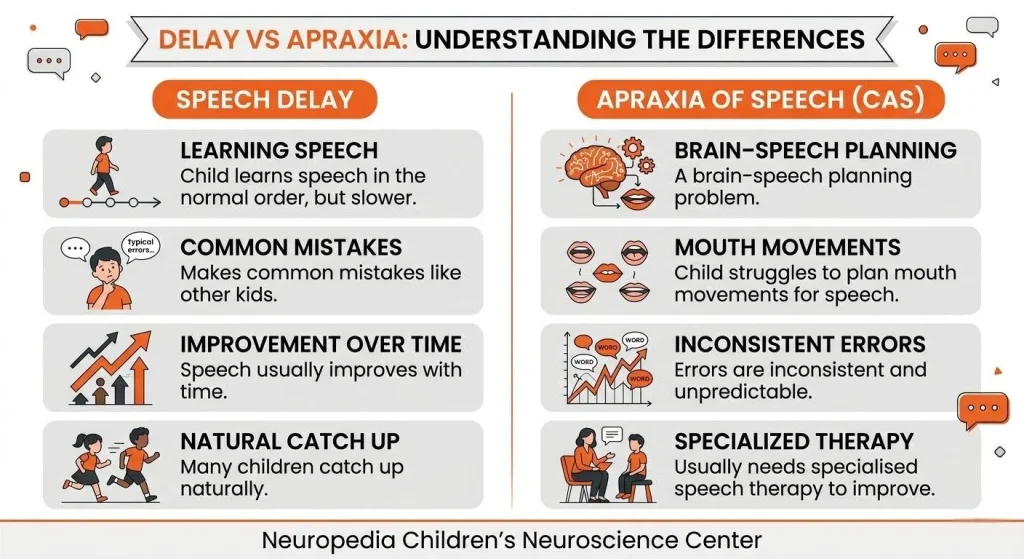
While both can result in a child who speaks little, the underlying mechanisms are very different.
Speech delay: A child with a delay follows the “typical” path of development but at a slower rate. They make the same mistakes most children make—like substituting a “w” for an “r”—but they eventually catch up.
Apraxia of speech: This is a neurological “misfire” in planning. Children with CAS do not follow the typical developmental path. Their errors are often inconsistent and unpredictable. Unlike a delay, children rarely “outgrow” apraxia without intensive, specialised intervention.
Early Signs of Childhood Apraxia of Speech
Early detection is vital for better outcomes. While a formal diagnosis usually cannot be made until a child is at least 2 or 3 years old, there are early signs of childhood apraxia of speech that parents can look for in infants and toddlers.
In infants (Birth to 18 months)
- The “Quiet baby”: You may notice very little cooing or babbling. Infants with CAS often don’t “play” with sounds as their peers do.
- Limited sound variety: They might only use one or two vowel or consonant sounds repeatedly.
- Late first words: While common in many delays, the total absence of words by 18 months is a significant red flag.
In toddlers (2 to 4 Years)
- Inconsistent errors: This is a hallmark of apraxia of speech symptoms. Your child might say a word perfectly one day but be unable to repeat it the next, or they may say the same word three different ways in the same minute.
- Groping for sounds: You might see your child visibly struggling to get their mouth into the right position. It may look like they are “searching” for the sound with their lips or tongue.
- Vowel distortions: Most speech delays involve consonants. If your child struggles to produce clear vowel sounds (the “a, e, i, o, u” sounds), it is a strong indicator of CAS.
- Prosody (Rhythm) issues: Their speech may sound robotic, monotone, or “choppy,” with equal stress placed on every syllable (e.g., saying “BA-NA-NA” instead of “ba-NA-na”).
Key Childhood Apraxia of Speech Symptoms to Monitor
As your child grows, the symptoms of apraxia of speech become more distinct. If you notice a combination of these markers, it is time to consult a paediatric neurologist or a specialised speech-language pathologist (SLP).
Difficulty with long words: A child might handle “cat” fine, but completely lose the ability to sequence the sounds in “caterpillar.”
Regression: Losing words that they previously seemed to have mastered.
Better receptive than expressive language: Your child clearly understands everything you say, but they cannot formulate the verbal response they want to give.
Automatic vs Volitional speech: They might say “Hi” or “Thank you” automatically, but when you ask them to say “Hi” on command, they struggle to do so.
Diagnosis and Treatment for Apraxia of Speech
At Neuropedia, our multidisciplinary approach ensures that we don’t just look at the speech; we look at the whole child. Because CAS is a neurological motor-planning issue, the treatment for apraxia of speech differs from traditional speech therapy.
The Diagnostic Process
A diagnosis requires a comprehensive evaluation by an SLP who is experienced in motor speech disorders. They will assess:
- Oral motor skills: Checking for muscle strength (to rule out dysarthria) and coordination.
- Speech consistency: How the child repeats the same word multiple times.
- Melody of speech: Analysing rhythm and stress patterns.
Evidence-based Treatment
The “gold standard” for CAS is intensive, individual speech therapy.
- Motor learning: Therapy focuses on practising the movements rather than just the sounds.
- Frequency: Unlike a simple delay, apraxia often requires 3 to 5 sessions per week for the brain to build the necessary pathways.
- Multisensory cues: We use visual (watching the therapist’s mouth), tactile (touching the jaw or lips), and auditory cues to help the child “feel” the correct movement.
- Alternative communication (AAC): To reduce frustration, we may use sign language or tablets while the child’s verbal speech is developing. This does not hinder speech; it actually helps bridge the gap.
Why early intervention matters at Neuropedia?
The brain’s plasticity is at its peak before the age of five. By addressing childhood apraxia of speech early, we can help children build the foundational motor plans they need to succeed in school and social settings.
If you find yourself constantly saying, “I know they know the word, they just can’t get it out,” don’t wait for them to “grow out of it.” Expert intervention can give your child the tools they need to find their voice.
Is your child struggling to communicate? Book a consultation with the expert team at Neuropedia today to get a clear answer and a path forward.

.png)


